
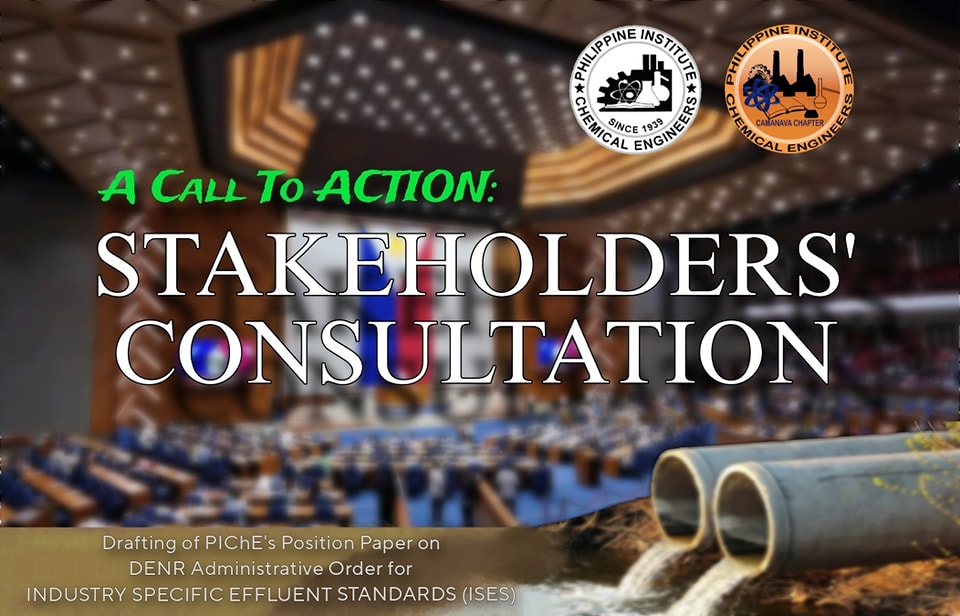
From Industry-Specific Effluent Standards to Action: The Crucial Role of Chemical Engineers in the Philippines’ Environmental Future
by: Engr. Joshua Bon A. Roco, AAE
TThe Philippines, like many other countries, faces the pressing challenge of managing industrial wastewater effectively. As industrialization continues to grow, the need for more robust environmental regulations becomes increasingly vital. The Department of Environment and Natural Resources (DENR) has commendably proposed the establishment of Industry-Specific Effluent Standards (ISES) to address the challenges posed by industrial wastewater discharge. This proposal represents a significant step toward more targeted and efficient regulation of industrial effluent, recognizing that wastewater discharge characteristics vary significantly across different industrial sectors. Through ISES, the DENR seeks to set achievable effluent limits that reflect the diversity of industrial processes and the varying capabilities of industries to treat their wastewater.
In this article, we explore the concept of ISES and how Chemical Engineers play a central role in its successful implementation. We will look at the principles of wastewater management, the importance of industry-specific standards, and the crucial contributions that Chemical Engineers can make in designing, operating, and optimizing wastewater treatment systems. By leveraging the expertise of Chemical Engineers, we can ensure that the ISES framework is both scientifically sound and practically achievable, helping the Philippines move closer to its environmental protection goals.
Understanding Industry-Specific Effluent Standards (ISES)
The Industry-Specific Effluent Standards (ISES) are a regulatory framework proposed by DENR to set wastewater discharge standards that are tailored to the characteristics of different industrial sectors. The basic premise behind ISES is to move beyond generalized effluent limits, such as the General Effluent Standards (GES), which apply uniformly to all industries. Instead, ISES recognizes that each industry produces wastewater with unique characteristics—be it high chemical oxygen demand (COD), biological oxygen demand (BOD), heavy metals, or other pollutants. As such, it is necessary to set specific effluent limits based on the particular characteristics of the wastewater produced by each sector.
The ISES framework draws inspiration from international best practices, such as the Effluent Limitations Guidelines (ELGs) in the United States. These technology-based standards are designed for different industrial categories, often based on the performance of wastewater treatment technologies. For example, the US EPA has developed ELGs for various sectors, including the chemical, textile, and food processing industries. These guidelines provide a framework for regulating wastewater discharges by setting achievable limits that reflect the best available technology.
The proposed ISES framework in the Philippines mirrors this approach by setting achievable and representative effluent limits, based on data from well-performing facilities within each industrial sector. Moreover, the inclusion of Best Achievable Technologies (BAT) further strengthens the framework. By integrating BAT, ISES aims to ensure that the most effective, efficient, and sustainable wastewater treatment technologies are employed across various industries.
International frameworks, including those in South Korea, combine technology-based approaches (which use effluent data and statistical analysis) with water quality-based approaches (which consider the risk posed by wastewater discharges and the capacity of receiving waters to assimilate pollutants). The proposed ISES also takes a similar dual approach by requiring industries to consider the assimilative capacity of receiving water bodies. This ensures that stricter standards are applied in sensitive or ecologically important areas, where wastewater discharges can have a more profound impact on water quality and ecosystem health.
The Crucial Role of Chemical Engineers in ISES Implementation
Chemical Engineers are at the forefront of addressing wastewater treatment challenges, playing an indispensable role in the design, implementation, and optimization of industrial wastewater treatment systems. Chemical engineers are highly trained to apply principles of Unit Operations (such as filtration, membrane separation, adsorption, and settling) and Unit Processes (such as biological treatment, chemical oxidation, and advanced oxidation processes) to create effective solutions for wastewater treatment. With their knowledge and experience, chemical engineers are uniquely positioned to ensure that the proposed ISES framework is both technically feasible and environmentally sustainable.
1. Understanding Industry Wastewater Characteristics
One of the fundamental challenges in wastewater treatment is understanding the specific characteristics of the wastewater generated by different industries. Industrial wastewater can vary widely in terms of chemical composition, pollutant concentrations, and physical properties. For example, the wastewater from food processing plants may have high organic content, while the wastewater from electronics manufacturing may contain hazardous metals like lead, mercury, and cadmium.
Chemical engineers are trained to analyze and characterize these complexities. They understand the chemical processes involved in industrial wastewater generation and can identify the types of pollutants present in wastewater streams. This knowledge allows chemical engineers to design customized treatment solutions for specific industries. These guidelines provide a framework for regulating wastewater discharges by setting achievable limits that reflect the best available technology.
The proposed ISES framework in the Philippines mirrors this approach by setting achievable and representative effluent limits, based on data from well-performing facilities within each industrial sector. Moreover, the inclusion of Best Achievable Technologies (BAT) further strengthens the framework. By integrating BAT, ISES aims to ensure that the most effective, efficient, and sustainable wastewater treatment technologies are employed across various industries.
International frameworks, including those in South Korea, combine technology-based approaches (which use effluent data and statistical analysis) with water quality-based approaches (which consider the risk posed by wastewater discharges and the capacity of receiving waters to assimilate pollutants). The proposed ISES also takes a similar dual approach by requiring industries to consider the assimilative capacity of receiving water bodies. This ensures that stricter standards are applied in sensitive or ecologically important areas, where wastewater discharges can have a more profound impact on water quality and ecosystem health.
The Crucial Role of Chemical Engineers in ISES Implementation
Chemical Engineers are at the forefront of addressing wastewater treatment challenges, playing an indispensable role in the design, implementation, and optimization of industrial wastewater treatment systems. Chemical engineers are highly trained to apply principles of Unit Operations (such as filtration, membrane separation, adsorption, and settling) and Unit Processes (such as biological treatment, chemical oxidation, and advanced oxidation processes) to create effective solutions for wastewater treatment. With their knowledge and experience, chemical engineers are uniquely positioned to ensure that the proposed ISES framework is both technically feasible and environmentally sustainable.
1. Understanding Industry Wastewater Characteristics
One of the fundamental challenges in wastewater treatment is understanding the specific characteristics of the wastewater generated by different industries. Industrial wastewater can vary widely in terms of chemical composition, pollutant concentrations, and physical properties. For example, the wastewater from food processing plants may have high organic content, while the wastewater from electronics manufacturing may contain hazardous metals like lead, mercury, and cadmium.
Chemical engineers are trained to analyze and characterize these complexities. They understand the chemical processes involved in industrial wastewater generation and can identify the types of pollutants present in wastewater streams. This knowledge allows chemical engineers to design customized treatment solutions for specific industries, ensuring that the ISES standards reflect the actual wastewater characteristics of each sector.
2. Assessing and Implementing Treatment Technologies
Another critical aspect of ISES is the use of Best Achievable Technologies (BAT) to treat industrial wastewater. BAT refers to the most advanced and effective technologies that can be employed to reduce or eliminate pollutants from wastewater. Chemical engineers play a pivotal role in identifying, evaluating, and implementing these technologies in industrial settings.
Chemical engineers are involved in the planning, design, and operation of wastewater treatment plants (WWTPs), ensuring that the technologies employed are capable of meeting the required effluent limits. They are skilled in optimizing existing treatment processes and ensuring that treatment systems are operating at peak efficiency. This can involve the use of membrane filtration systems, biological treatment methods, chemical precipitation, or advanced oxidation processes.
Chemical engineers are also instrumental in evaluating the performance of treatment technologies and recommending improvements to meet ISES standards. They understand the limitations of various treatment methods and can select the most appropriate technology based on the specific characteristics of the wastewater being treated.
3. Developing Technically Justified Standards
The development of ISES standards requires a thorough understanding of both the technical feasibility of treatment technologies and the environmental impact of wastewater discharges. Chemical engineers can contribute to the formulation of effluent limits by providing technical data, conducting performance evaluations, and analyzing sector-wide conditions. This involvement ensures that the proposed effluent standards are not only based on real-world data but are also achievable and aligned with the capabilities of existing and emerging treatment technologies.
By participating in the development of ISES standards, chemical engineers help ensure that the limits set are technically justified. This is essential because standards that are too stringent or unrealistic may burden industries, especially small and medium-sized enterprises (SMEs), making compliance difficult or cost-prohibitive. On the other hand, standards that are too lenient may fail to adequately protect the environment and public health.
4. Addressing Economic Burdens, Especially for SMEs
While the implementation of ISES is essential for environmental protection, it can also place significant economic burdens on industries, particularly small and medium-sized enterprises (SMEs). These industries often lack the financial resources to invest in advanced treatment technologies or to modify their operations to meet stringent effluent limits.
Chemical engineers can play a crucial role in addressing these economic challenges by identifying cost-effective solutions that allow SMEs to comply with ISES. By optimizing treatment processes, improving the efficiency of wastewater treatment plants, and selecting the most appropriate technologies, chemical engineers can help industries meet regulatory standards without incurring excessive costs.
Moreover, chemical engineers can help SMEs identify opportunities for resource recovery, such as the recovery of energy or valuable by-products from wastewater. These innovations can help offset the costs of treatment and make compliance with ISES more economically viable.
5. Supporting SMEs and Removing Volume Limitations
The proposed ISES framework focuses on larger industrial facilities that discharge significant volumes of wastewater (e.g., over 100 m³/day). However, many SMEs produce wastewater that may require specific treatment, even if their discharge volumes are lower than the threshold set by ISES. These industries, though small in size, can have wastewater characteristics that pose unique treatment challenges.
Chemical engineers can support SMEs by removing volume-based limitations on ISES applications. By doing so, these SMEs would be able to apply for industry-specific standards that are more appropriate for their wastewater characteristics. Chemical engineers can assist these SMEs by evaluating their wastewater, recommending suitable treatment options, and helping them meet the required effluent limits, even if their discharge volumes are below typical thresholds.
6. Ensuring Sustainable Operations
The overarching goal of ISES is not only to regulate wastewater discharges but to encourage sustainable industrial practices. Chemical engineers are trained to design and operate wastewater treatment systems that are environmentally sustainable, ensuring that they operate efficiently over the long term. They are experts in optimizing water and energy use in treatment processes, reducing waste generation, and ensuring that treatment plants operate within budgetary constraints.
By integrating sustainable practices into wastewater treatment, chemical engineers can help industries reduce their environmental impact while ensuring compliance with ISES. Moreover, the knowledge of chemical engineers extends beyond wastewater treatment to include resource management, energy optimization, and pollution prevention, all of which contribute to the long-term sustainability of industrial operations.
A Call for Active Involvement
The successful implementation of ISES depends on the active participation of all stakeholders, including industries, regulatory agencies, local governments, and communities. The DENR’s proposed ISES framework recognizes the importance of stakeholder engagement and includes provisions for public consultations, workshops, and public hearings. These efforts aim to ensure that the regulatory framework is transparent, inclusive, and socially acceptable.
As chemical engineers, our role in these discussions is critical. Whether through professional organizations like the Philippine Institute of Chemical Engineers (PIChE) or by directly engaging with individual companies, our expertise is essential in shaping a regulatory framework that is both scientifically rigorous and practically feasible. By participating in public consultations, offering technical guidance, and providing innovative solutions, chemical engineers can help ensure that ISES is effective in achieving its goals of environmental protection and sustainable industrial development.
Conclusion
The proposed Industry-Specific Effluent Standards (ISES) represent a significant step forward in the Philippines’ efforts to regulate industrial wastewater and protect the environment. Chemical engineers are at the heart of this regulatory initiative, with the knowledge, expertise, and technical skills needed to ensure that the standards are both achievable and effective.
By actively participating in the development, implementation, and ongoing optimization of ISES, chemical engineers can help industries comply with environmental regulations while promoting sustainable practices. Whether it’s through the design of treatment systems, the optimization of processes, or the support of SMEs, chemical engineers are crucial to the successful realization of ISES. As the Philippines works towards its environmental protection goals, chemical engineers will continue to play a key role in shaping a cleaner, more sustainable future for the country.
References:
Adulyadej, B. (n.d.). Enhancement and Conservation of National Environmental Quality Act, B.E. 2535.
Brinkmann, T., Giner Santonja, G., Yükseler, H., Roudier, S., & Delgado Sancho, L. (n.d.). Best Available Techniques (BAT) Reference Document for Common Waste Water and Waste Gas Treatment/Management Systems in the Chemical Sector – Industrial Emissions Directive 2010/75/EU (Integrated Pollution Prevention and Control).
Cach Tuyen, B. (2012). Promulgating together with this Circular the National Technical Regulation on Environment: QCVN 40:2011/BTNMT-National Technical Regulation on Industrial Wastewater. Article 2. This Circular takes effect on.
Dong, F., Pan, Y., Li, Y., & Zhang, S. (2021). How public and government matter in industrial pollution mitigation performance: Evidence from China. Journal of Cleaner Production, 306. https://doi.org/10.1016/j.jclepro.2021.127099
Effluent Standards. (n.d.).
Environmental Protection and Management. (N.D.).
Epa, U., of Research, O., Transfer, T., Division, S., & Paris, L. (2004). US EPA Guidelines for Water Reuse.
Epa, U., & of Science, O. (2023). United States Environmental Protection Agency Effluent Guidelines Program Plan 15.
Global Effluent Guidelines. (n.d.).
Google. (2025). NotebookLM [AI research tool]. Retrieved March 24, 2025, from https://notebooklm.google.com/notebook/
Guidelines – EU Industrial Emissions Directive. (n.d.).
Guidelines – UNEP Guidelines for Updating National Action Plans. (n.d.).
I establishing a framework for Community action in the field of water policy. (2000).
Jung, J.-Y., Kim, I., & Hong, S.-H. (2010). Establishment of Effluent Standards for Industrial Wastewaters in Korea: Current Issues and Suggestions for Future Plan. In Journal of Water and Environment Technology (Vol. 8, Issue 3).
LAW ON ENVIRONMENTAL PROTECTION AND NATURAL RESOURCE MANAGEMENT CHAPTER I: GENERAL PROVISIONS. (n.d.).
Li, X., Shen, X., Jiang, W., Xi, Y., & Li, S. (2024). Comprehensive review of emerging contaminants: Detection technologies, environmental impact, and management strategies. In Ecotoxicology and Environmental Safety (Vol. 278). Academic Press. https://doi.org/10.1016/j.ecoenv.2024.116420
Mokhtar, Z., Kenway, S., & Pikaar, I. (2025). Alternative assessment of industrial effluent compliance: A case study of stakeholders’ perspectives in Malaysia. Journal of Cleaner Production, 495. https://doi.org/10.1016/j.jclepro.2025.144776
Olmstead, S., & Zheng, J. (n.d.). Policy Instruments for Water Pollution Control in Developing Countries. www.worldbank.org/gwsp
Park, T.-J. (n.d.). “건강한 환경 행복한 미래" Recent efforts in industrial wastewater regulation in Korea The 15 th WEPA International Workshop 6 February 2020 Bangkok.
Park, T.-J. (2023). Updates on Industrial Wastewater management in Republic of Korea The 18 th WEPA Annual Meeting.
Proposed DENR ISES. (n.d.).
RA 9297. (n.d.).
Ragas, A. M. J., Scheren, P. A. G. M., Konterman, H. I., Leuven, R. S. E. W., Vugteveen, P., Lubberding, H. J., Niebeek, G., & Stortelder, P. B. M. (n.d.). Effluent standards for developing countries: combining the technology-and water quality-based approach.
Republic of the Philippines Congress of the Philippines Metro Manila An Act Providing For A Comprehensive Water Quality Management and Other Purposes. (2004).
Republic of the Philippines (n.d.). Republic of the Philippines Department of Environment and Natural Resources Subject: Updated Water Quality Guidelines (WQG) And General Effluent Standards (Ges) For Selected Parameters. www.denr.gov.ph
Singapore Statutes Online Environmental Protection and Management Act 1999 Table of Contents Long Title Part 1 PRELIMINARY 1 Short title 2 Interpretation Part 2 ADMINISTRATION 3 Appointment of Director-General and authorised officers 4 Public servants 5 Protection from personal liability Part 3 USE OF SCHEDULED PREMISES 6 Written permission for use of scheduled premises. (n.d.).
Singh, B. J., Chakraborty, A., & Sehgal, R. (2023). A systematic review of industrial wastewater management: Evaluating challenges and enablers. In Journal of Environmental Management (Vol. 348). Academic Press. https://doi.org/10.1016/j.jenvman.2023.119230
The Water Environment (Water Framework Directive) (England and Wales) Regulations 2017. (n.d.).
Tom. (n.d.). Lao People’s Democratic Republic Peace Independence Democracy Unity Prosperity Environmental Protection Law (Revised Version) 2013 1.
Tuddao, V. B., Erlinda, E., & Gonzales, A. (n.d.). Situation of Industrial Wastewater Regulation in the Philippines.
Vic. (2016). Republic of the Philippines Department of Environment and Natural_ Resources. http://www.denr.gov.phI
Wastewater Treatment and Engineering Rumana Riffat. (N.D.).
No responses yet